Google

Google Pack

Blog Archive

Showing posts with label Engine. Show all posts

Spinning


Spinning The proses of drawing out and twisting fibres into a strong thread suitable for weaving. The first machine for spinning was the spinning wheel (1500s), which was a mechanical means of drawing out and twisting the fibres and winding the thread so formed on a bobbin.

In the 18th century the invention of tree spinning machines made textile making an industry and launched the industrial revolution. They were
James Hargreaves' spinning Jenny (1767);
Richard Arkwright's spinning frame (1769);
Samuel Crompton's spinning mule (1779);

The mule is still used today. It has a movable carriage holding a rotating bobbin. The thread is drawn out as the carriage moves back. The other main modern machine is the ring spinning frame. It has a rotating bobbin that draws out the thread, while a 'traveller' revolves around the bobbin on a ring and imparts the twist.

Underground Railway


Underground Railway Also called Subway ; a railway that runs mainly underground. The first underground railway built just below street level opened in London in 1863, and was operated by steam locomotives, The first deep-level tube, operating in bored tunnels by electric locomotives, opened in London in 1890.

The Paris Metro, opened in 1900, differs from most other underground systems in having pneumatic tyres. Underground systems are becoming increasingly popular in large cities that suffer from traffic congestion in the streets. Underground trains have no separate locomotives, being powered by electric motors installed in the passenger cars. They pick up electricity either from a third rail by the track (London Underground) or an overhead wire (Metro).

Submarine


Submarine A ship capable of operating underwater. The first prototype modern submarine did not appear until 1898. Powered by electric motors underwater and a petrol engine on the surface, it was designed by J.P. Holland. Later submarines had a diesel engine for use on the surface and to charge the batteries. In 1954 the Americans launched the first nuclear submarines, Nautilus. Nuclear submarines have a boiler to raise steam and steam turbines for propulsion. Submarines dive and surface by letting water into and expelling it (with compressed air) out of ballast tanks.

Submersible The name usually given to small submarine craft used, for example, to make underwater surveys and to assist divers. They may be equipped with mechanical arms and diving chambers.

Clutch


Clutch A device for disconnecting rotating shafts in power transmission system, such as a car transmission. A friction clutch uses a pair of mating discs or cones, which are forced together and apart by springs and levers.

Locomotive


Locomotive a vehicle used to haul trains. Cornishman Richard Trevithick built the first steam locomotive in 1804 for the tramway at pen-y-darran in South Wales. But not until George Stephenson designed Rocket (1829) was the locomotive a reliable machine. From then on the railways developed rapidly worldwide. Today steam locomotive have been superseded practically everywhere by electric and diesel locomotives.

Electric locomotives may pick up their power from a live third rail alongside the track or, via a pantograph, from an overhead power line.
Diesel Locomotives are powered by diesel engines, and one of three types of power transmission is most common. Gas-turbine locomotives are now coming into more widespread use. They include the fast French Turbo trains a Grande Vitesse (TGVs).

Brake


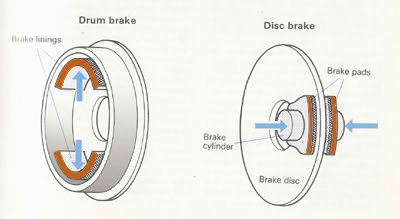
Brake a device used to slow down or stop the movement of a body. Most vehicle brakes work on the principle of friction. They may operate by means of mechanical linkages, or by hydraulic or air pressure. car brakes operate hydraulically on all four wheels when the brake pedal is pressed. The hand, or parking brake works mechanically just on the rear wheels.

In the disc brake, breaking pressure forces pads against both sides of a disc that is attached to the wheel.
In the drum brake pedal pressure forces a brake shoe against a drum that is attached to the wheel.
The pads and shoes have a tough wear and heat resistant lining.

Hovercraft


Hovercraft or air-cushion vehicle an amphibious craft that glides over a surface on a cushion of compressed air. The air is compressed by a fan and delivered through inward pointing jets underneath the craft. To reduce the rate of escape of the air, many hovercraft have flexible skirts around their base. They are generally powered and steered by means of backward facing propellers

Turboprop ( Gas turbine )


Gas turbine an internal combustion engine that burns fuel to produce hot gases, which spin a turbine to produce power. The jet engine is a form of gas turbine. In a typical gas turbine, air is taken in, compressed by a compressor and fed to a combustion chamber. Fuel is introduced and ignited in the compressed air, and the hot gases exhaust through the turbine. Power is taken from the turbine to drive the compressor

Carburettor


Carburettor A device used in a petrol engine to mix petrol with air to form an explosive vapour. It incorporates a float chamber, which supplies a constant head of petrol to a jet that sprays it into the air stream

Rocket


A missile or launch vehicle propelled by reaction, which carries both fuel and the oxygen to burn the fuel. Because of this, it can work in airless space. The fuel and oxidizer (oxygen-provider) are called the propellants. The Chinese are thought to have used rockets first some 750 years ego, employing gunpowder as a propellants. Most space launch vehicles,however, have liquid propellants. The largest successful rocket was the American Saturn V, 111m(365ft) long with a take off thrust of 3.4 million kg (7.5million lb), built for the Apollo Moon-landing missions.

Ariane rocket The heavy launch vehicle for the European space agency (ESA), which was first flight tested in 1979. Standing some 47.5m (155ft) high on the launch pad ,its first two stages burn hydrazine and nitrogen tetroxide as propellants, while the third stage burns liquid hydrogen/oxygen.
.

Two stroke cycle


An Operating cycle of an internal combustion engine which is repeated every two piston strokes. Many motorcycles and lawnmowers have a two-stroke petrol engine; some large marine diesel engines are two stroke. In a typical petrol engine two stroke cycle, fuel is drawn into the crankcase via the inlet port as the piston moves up to compress mixture is then ignited and the piston is forced down on its power stroke, the exhaust port and transfer port are uncovered. Fresh fuel mixture enters the cylinder and forces out the burnt gases through the exhaust port.

Wankel Engine


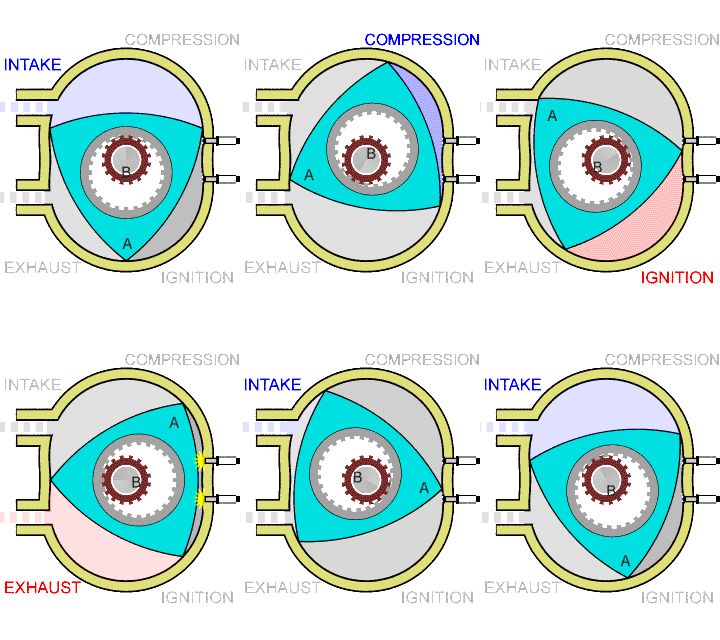
A novel kind of rotary petrol engine invented by German engineer Felix Wankel in the 1950s. It uses a triangular rotor moving eccentrically in a figure of eight chamber. The four stroke petrol engine cycle take place in different segments of the chamber. The Wankel engine has been used successfully in a few cars, including the Mazda RX7

Turbojet Engine


A type of gas turbine, or jet engine, that derives its thrust wholly from a rearward jet of hot gases. in a simple turbojet, air is taken in through the front of the engine and compressed by a compressor. The compressed air then feeds through nozzles into a combustion chamber, fuel is sprayed in, and the mixture is ignited. The hot gases produced expand through a turbine (which drives the compressor ) before escaping at high speed through a rear nozzle. reaction to the rearward jet produces a forward propulsive thrust. Practical turbojets hove two or more compressor and turbine stages.

Four Stroke Cycle


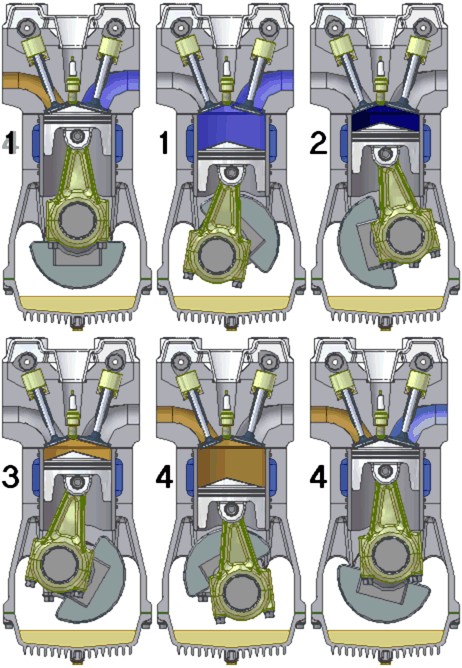
Four Stroke Cycle Or Otto Cycle, the operating cycle of most petrol and diesel engines, based upon the strokes or up and down movements of the pistons. It was first Exploited in 1876 by the German engineer Nicolaus August Otto. In the four stroke petrol engine cycle, petrol air mixture is drawn into an engine cylinder on the first stroke (down) of the piston. On the second stroke (up) the mixture is ignited by a spark. The mixture burns and produces gases that drive the piston down on its third, or power stroke. As the piston moves up on its fourth, exhaust stroke, it expels burnt gases from the cylinder.

Diesel Engine


An internal combustion piston engine that works by the compression ignition of oil, named after its German inventor Rudolf Diesel who patented it in 1892. Diesel engines are widely used to power lorries, buses, locomotives , ships and many more. They are in general cheaper to run than petrol engines but require more robust construction because of the higher pressures developed inside their cylinders. In the four-Stroke diesel engine cycle, air is drawn into the engine cylinder on the first down stroke of the piston. It is compressed and is raised to a high temperature as the piston moves up. Oil is then injected into the cylinder and ignites immediately, forming gases that force the piston down on its power stroke. On the next (upward) piston stroke the piston expels the burnt gases. Two-stroke diesel engines

Steam Engine


Steam engine a machine that exploits the power of expanding steam. It is an external combustion engine, steam the working fluid is prodeced outside the engine by heating water in a boiler. The engine consists essentially of a piston in a cylinder Steam is introduced to each side of the piston in turn double action, driving itback and forth. The motion is carried by a connecting rod to say the wheels of a locomotive the first practical steam machine, used to pump water from mines, was Thomas Savery's steam pump 1968, which operated by means of valves but the forerunner of the reciprocating steam engine that was to power the industrial revolution was Thomas Newcomen's beam engine of 1712. James Watt brought out a greatly improved design in 1769 and by the 1790s had produced a powerful and reliable power source, capable of rotary motion and controlled by a governor. Steam engines were also successfully introduced to power ships and locomotives.


Read from E-Mail

Enter your email address:

Delivered by FeedBurner

Google

 
template by batarawisnu